George Clarke takes The Great Green Challenge to Bolton to test solar panel myths
“Do solar panels work when it’s cloudy?”
I hear it all the time. In fact, more than a third of people1 we spoke to in our research believe solar panels only work when it’s sunny.
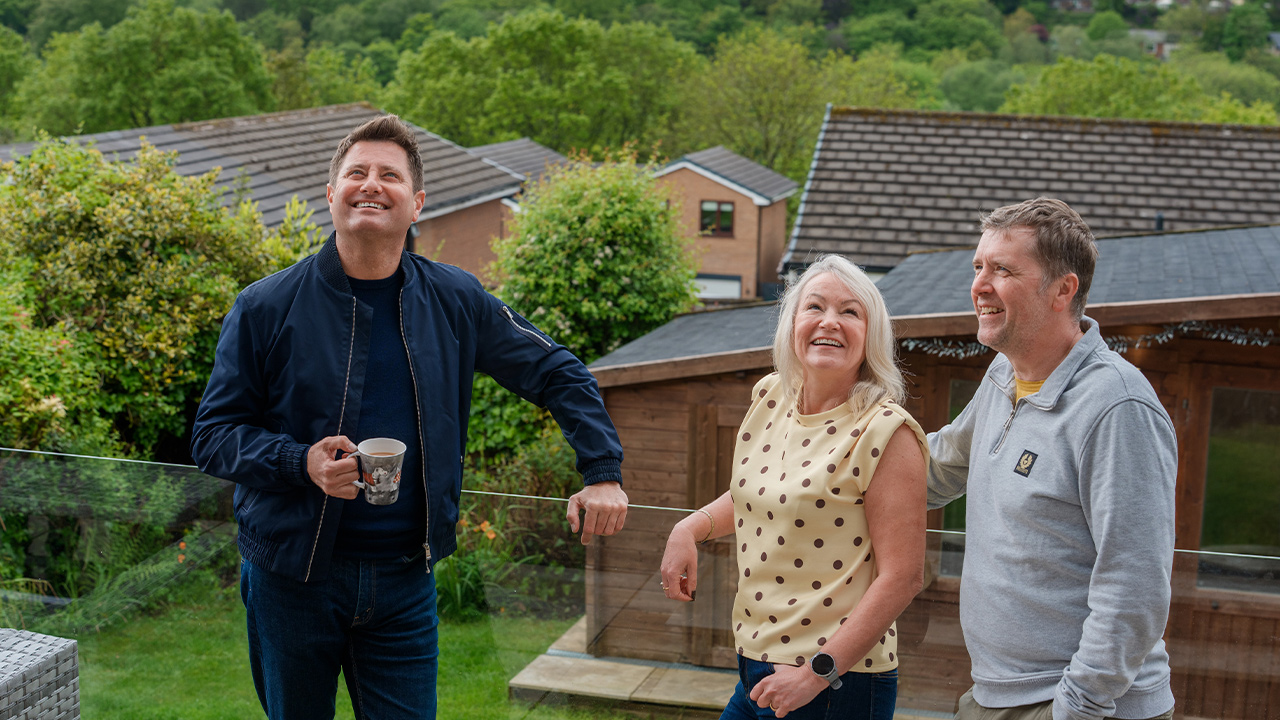
I wanted to test the myth properly by meeting Mark and his family in Bolton for the second stop on The Great Green Challenge on Tour. Bolton isn’t known for its tropical sunshine, so it was a great opportunity to find out how well solar panels work in real homes like Mark’s, and prove that solar panels can perform anywhere in the UK – regardless of the weather.
Meeting Mark in Bromley Cross
I met Mark and his family in Bromley Cross. Mark and his partner Amanda have always been passionate about sustainability, and when they found their forever family home, they wanted to make sure they were making it as energy efficient as possible for years to come. That’s when they started to think about solar.
Before taking the leap, Mark did his own research, which showed that solar panels only need daylight to generate electricity, not direct sunshine. Knowing that solar panels will produce electricity even on overcast days gave Mark the confidence to put his research to the test.
What years of living with solar actually taught him
Mark told us that when their solar panels were temporarily removed during roof repairs last year, their household energy bills doubled during that period – proving just how much of a difference their solar panels had made over the years.
When I asked Mark why he thinks more people aren’t making the leap to solar, he suggested there might be a lack of awareness of how much difference they can make. He also thought people may have concerns about how much electricity solar panels can actually generate, or that the cost of installation will never be recovered.
These concerns were clearly reflected in our research:
- 50%1 of respondents said they thought the solar panel payback period was too long
- 48%1 were unsure of the impact of solar panels on their energy bills.
Those concerns, as well as the assumption that the UK isn’t sunny enough for solar panels to work efficiently, explain why there’s still a lot of uncertainty out there.
Why people still aren’t sure about getting solar panels
So, if the answer to “do solar panels work when cloudy?” is clearly yes, why is there still hesitation around solar?
A few reasons might be that a lot of people still:
associate solar with heat, not light
compare the UK to sunnier countries
focus on worst-case weather (grey days) instead of yearly totals
But real homes like Mark’s tell a different story. Solar panels across the UK still generate electricity year-round using the daylight we get, not the sunshine we wish we had.
Final takeaway
Solar panels don’t need sunshine, they need daylight. And as my trip showed, that’s something the UK has plenty of - even on a cloudy day in Bolton.
The panels on Mark’s roof don’t wait for perfect weather. Instead, they turn everyday daylight into electricity, which then turns into household savings2.
If you’re looking for more information about how solar panels could work for you – even on cloudy days – we’ve got more on our blog.
You can also get a personalised solar quote from us online or speak to a ScottishPower solar expert for tailored advice. We’ll provide you with a full solar panel and solar battery proposal for your home, including costs and recommendations, free of charge.
1
The research was conducted by Censuswide, among a sample of 2,000 nationally representative UK consumers (aged 18+). The data was collected between 20.02.2026 - 23.02.2026 Censuswide abides by and employs members of the Market Research Society and follows the MRS code of conduct and ESOMAR principles. Censuswide is also a member of the British Polling Council.
2
Our solar panels start from £4295. Price is based on a 4 Panel “Electrify” package (on-roof) in Central England, fitting to concrete tiles (not slate), single elevation of scaffold, with single-phase electrics, and no complexities, for example installing above a conservatory or digging trenching required for electrics.
Last updated: 12 August 2026