Your top heat pump questions answered with George Clarke
If you’re thinking about getting a heat pump, you’ve probably got questions.
How does it actually work? Will it work in the winter? Will it keep your home warm enough? And what actually happens when it’s installed?
ScottishPower’s Greener Living Ambassador George Clarke sat down with heat pump experts Rozlyn Brennan, Smart Solutions Director at ScottishPower, and Craig Smith, Specification Sales Manager at Mitsubishi Electric, to answer some of the most common questions about heat pumps.
Meet the experts
As an architect, TV presenter and passionate advocate for sustainable homes, our Greener Living Ambassador George Clarke knows the questions people have about making their home greener. And, as a heat pump owner himself, he brings his own first-hand experience to the conversation.
Rozlyn Brennan is Smart Solutions Director at ScottishPower. Alongside her team, she’s helping make technologies like heat pumps easier for customers to understand and making sure the products, tariffs and support available are built around real homes and everyday needs.
Craig Smith is Specification Sales Manager at Mitsubishi Electric and brings the technical expertise, helping to explain how heat pumps work and what they’re really like to have in your home.
Your questions answered
What is an air source heat pump?
Let’s start with the basics.
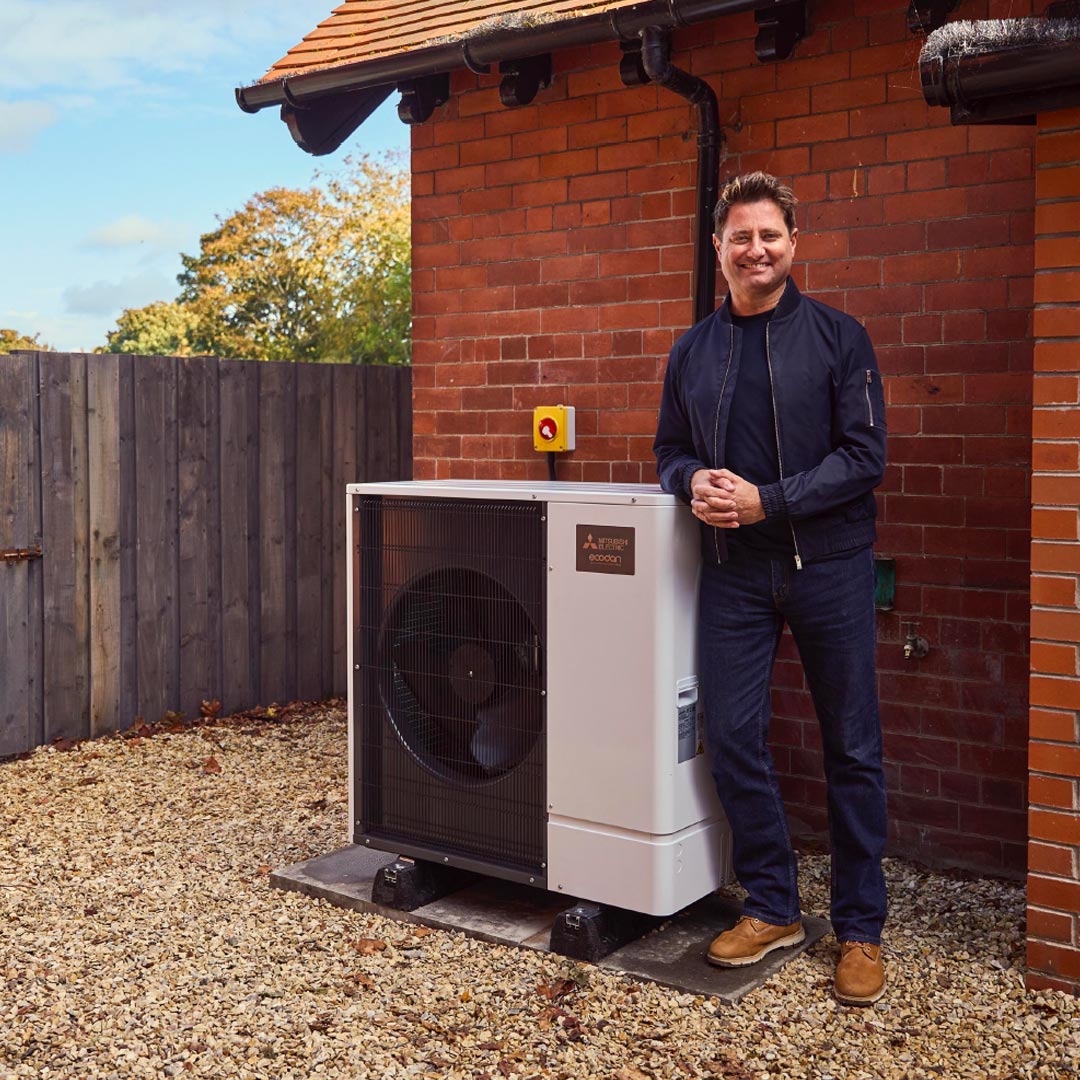
An air source heat pump is a low-carbon heating system that uses heat from the air outside to provide heating and hot water for your home.
The system usually consists of three main parts:
An outdoor unit that captures heat from the air
A hot water cylinder that stores hot water for your home
Your home’s heating system, such as radiators or underfloor heating
But how does it actually heat your home?
Craig explains how it works: ’A heat pump harnesses heat energy and transfers it into water, generating heat and hot water for your home from that energy.’
Even when it feels cold outside, there’s still heat energy in the air. The outdoor unit captures that energy and moves it into your home’s heating system, where it can be used to heat rooms and provide hot water for showers, baths and washing up.
George summed it up simply: ’It literally takes the heat from the outside air, compresses that, and makes it super, super hot."
And while the technology behind it is sophisticated, the setup itself is fairly straightforward.
Think of it like a fridge working in reverse. Instead of removing heat from inside a space, a heat pump captures heat from outside and brings it into your home.
What actually gets installed?
People often picture lots of complicated equipment.
In reality, the system is fairly straightforward.
Outside the home sits the heat pump unit.
Inside, you’ll usually have a hot water cylinder and your existing or upgraded heat emitters, such as radiators or underfloor heating.
Do heat pumps work in winter?
This is probably the question heat pump experts hear most often.
The simple answer is yes.
Even when temperatures drop outside, there’s still heat energy in the air that a heat pump can capture and use.
Craig explains: "Even when it’s cold outside, we can still take that energy because of the refrigerant within the outdoor unit and it can really harness that energy and bring it inside."
He points out that this energy is naturally available all around us. "It’s already there. It’s reoccurring. We have it from the air. It’s warmed by the sun and it’s there in the outside environment."
So while a freezing winter’s day might not feel warm to us, there’s still enough heat energy available for a correctly designed heat pump system to do its job.
Will a heat pump work in an older home?
Many homeowners assume heat pumps are only for new-build properties.
That’s not the case.
George himself actually has a heat pump installed in an older home, and plenty of new homes are being built with heat pumps as their heating solution. Every home is different, but most can be suitable when it comes to having an air source heat pump.
"Heat pumps definitely are not a one-size-fits-all solution," says Roz.
That’s why ScottishPower starts the process with a home survey and personalised system design.
"We really work with the customers. We understand their lifestyle, not just the size of their house, but how they live in it."
That means looking at things like:
The type of property
How many people live in the property
When hot water is needed
The size and layout of the home
Current insulation levels
Future plans for the property
And if your home isn’t quite heat-pump ready?
Roz says that’s no reason not to start exploring your options.
"It might not feel ready today, or it may be more optimal if you do things in the future, but you could still have a heat pump in your home working and be given a roadmap for how you could make that more efficient over time."
What happens during a heat pump assessment?
The assessment is all about understanding your home and how you live in it.
Roz explains: "Your heat pump installer through ScottishPower would come to your home to do a survey to help build essentially your personalised plan for your new heating system."
Part of that involves measuring heat loss throughout the property. But it’s not just about the building.
It’s also about your household.
"It’s a conversation to understand how many people live in your home, how often and when you need your hot water."
The assessment also looks ahead.
"You could have six adults right now and that’s soon going to be two or three adults. That would all be taken into consideration to make sure your home’s ready for today and tomorrow as well."
As George puts it: "Future-proofing along the way."
The goal isn’t just to design a system for how you live today. By understanding your household’s current and future needs, installers can make sure things like the hot water cylinder are sized correctly, helping to create a system that’s practical, efficient and future-proofed for the years ahead.
Will a heat pump keep my home warm enough?
Yes. But it works differently to a gas boiler.
Craig explains that one of the biggest misconceptions is expecting a heat pump to behave exactly like a traditional boiler.
With a boiler, you tend to get short bursts of very intense heat.
"With a gas boiler, the heat is very intense. Seventy to eighty degrees will be the water temperature."
A heat pump takes a different approach.
"With an air source heat pump, we’ll have lower temperatures but for long sustained periods of time."
Craig describes it as ’low and slow.’ The result is a more stable indoor temperature.
"If the temperature in your house is 21 degrees, it will still be 21 degrees with an air source heat pump that’s designed and installed correctly."
In fact, many homeowners find the comfort levels improve because there are fewer temperature swings throughout the day.
"An air source heat pump absolutely can do the same job as a gas boiler, but with more comfort."
Will I need new radiators?
Not necessarily.
Some homes can keep their existing radiators, while others may benefit from upgrades.
That’s why the survey and design stage is so important.
As Craig explains: "Some buildings have been designed efficiently from the get-go. Some need radiator upgrades or pipework upgrades."
The recommendation will depend entirely on your home. "If it’s fit for purpose, it can continue to be in the home. If it’s not fit for purpose, it’ll be upgraded."
There’s no one-size-fits-all answer, and that’s why the assessment comes first.
How disruptive is a heat pump installation?
It’s a big home improvement project, so it’s natural to wonder how much disruption is involved.
According to Roz, installers work hard to make the experience as stress-free as possible. "We really try to make sure it’s not overly disruptive."
Customers can normally stay in the property while work is taking place.
"You could still be in the home on the day. We make sure everything’s well covered and protected and that everything’s cleared up after the install."
The duration of the installation itself varies from home to home. The existing heating system will be removed and replaced with the new heat pump system that’s been specifically designed for the property.
Are there grants available?
There can be. The level of support available depends on where you live and your circumstances, and schemes can change over time.
That’s why Roz encourages homeowners to check current funding options when they start exploring a heat pump. "There are absolutely incentives. They do change, so checking what’s locally available to you is really important."
The good news is that customers are talked through all of this as part of the quotation process.
"We make sure our customers are supported, that they understand what they have to pay and also what’s going to happen when someone comes to their home."
Are heat pumps expensive to run?
Running costs are another topic that comes up in almost every conversation about heat pumps.
Roz is upfront that right now, electricity is more expensive than gas.
But that’s only part of the story.
Heat pumps are significantly more efficient than traditional heating systems because they’re moving heat rather than generating it through combustion.
"For every unit of energy that you’re putting in, you’re getting four times the amount out."
Pairing a heat pump with the right tariff can make a difference too.
"You can partner it with the right tariff that gives you a better unit rate on your electricity at key times of the day."
Learning how to use the controls and heating schedules properly is another important part of getting the best performance from the system.
What are the benefits of a heat pump?
For Craig, one of the biggest benefits is simplicity. Once installed and set up correctly, the system simply gets on with the job.
"Very easy to run. Very, very easy to use. Very user-friendly."
Unlike a traditional boiler, which often works in short bursts of high heat, a heat pump is designed to provide a steady, consistent temperature throughout the day. Once it’s set up correctly for your home and lifestyle, there should be little need to constantly adjust the controls.
Instead, it maintains a comfortable level of warmth in the background, helping to create a more stable and comfortable indoor environment.
Roz points to the wider benefits too.
Modern heat pumps can work alongside smart tariffs, battery storage and solar panels to create a more efficient energy setup for your home.
"You start thinking about one part of your home and then really thinking about that whole plan for your entire home."
What’s the first step?
Both experts had the same advice.
Get informed. Understand your home, understand your options and start building a plan.
A heat pump might be right for you today, or it might be part of a longer-term plan.
"Today, tomorrow might be absolutely the right time for you and your home. For other people it might be a year or two down the line."
And if you’re still unsure?
Craig’s advice is simple:
"Make the jump. I don’t think you’ll find it as difficult as what you maybe perceive it as."
You can find out more over on our heat pump webpage.
Watch George Clarke’s heat pump Q&A
Changing the way you heat your home is a big decision, and it’s not something you need to rush into.
With the right advice, the right design and the right support, a heat pump can provide the heating and hot water your home needs, delivering comfortable, consistent warmth throughout the year.
Watch the full conversation with George, Roz and Craig to hear their answers in full.
Last updated: 22 October 2026